
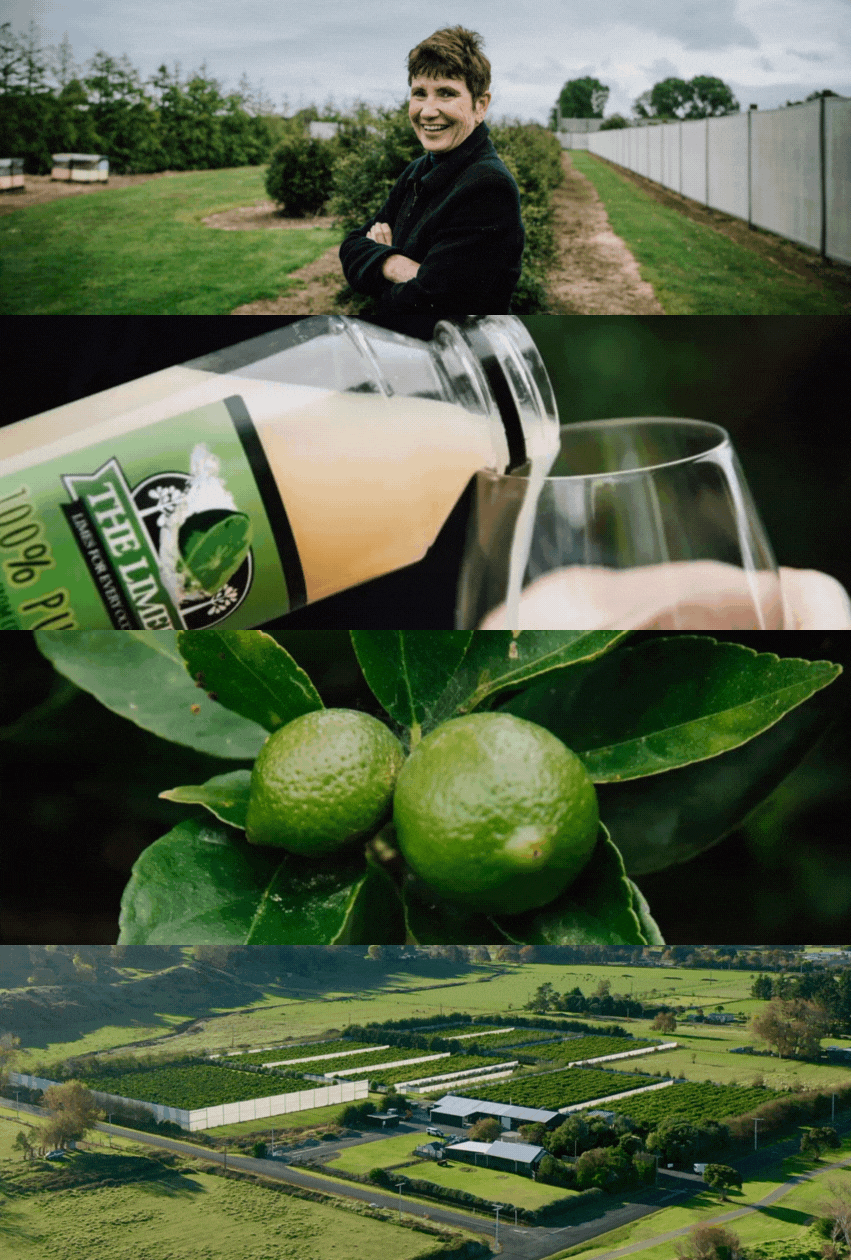
A 2025 Gold Medal for The Limery was accompanied by the judges praising its quality as "Authentic, endlessly versatile, unadulterated. True to label. Surprisingly moreish”. Development of The Limery is an inspiring tale of grit and resourcefulness from townies who wanted a change; Dianne Downey, who, alongside her late husband Paul Hyslop, turned four hectares of coastal land into an award-winning lime operation.
There is a certain madness essential to entrepreneurship. Whether that madness constitutes purchasing four hectares of unbroken land, sight unseen, in a town you cannot point to on a map, for a purpose you're not entirely sure of, simply because the listing was cheap and close to the ocean—well, that may be another story altogether.
Fortunately for lime-loving Kiwis, it happens to be the story of The Limery and of two ex-Aucklanders who fled the gridlock and daily grind for a place to tinker away their later years.
Dianne Downey and her late husband, Paul Hyslop, had always admired those who produced. In 2010, they decided to do the same, packing their bags and heading to a parcel of land where “the surf hits the turf at the mouth of the river". In the early days, tradies used to arrive with surfboards strapped to their vehicles, paddle across to the bar, and disappear into the swell for hours. Perhaps not ideal when working to a project timeframe, but such sacrifices can be made in pleasant places of birds and waves and limes. A place Dianne describes as "very in sync." A place with unique propositions that would gradually reveal its purpose.
Situated where the Wairoa River meets the Pacific, these fertile flats are reminiscent of the Nile: low-lying, rich, and flavoured by salt air. Here, sea spray provides natural pest protection, while the southerlies that lash the coast keep winter frosts at bay. But fifteen years ago, before any tradies had taken extended smoko, Dianne and Paul were still wondering what to do. They had yet to understand the geographic personalities of their new Kōpū Road estate. What they did understand, however, was that every backyard in Wairoa seemed to have a citrus tree. "A good indicator," Dianne thought.
At the time, oranges and lemons were plentiful and cheap. Limes, however, particularly in the off-season, were at prices exorbitant enough that the couple thought "a buck could be made.” And after a trip to Brazil, Florida, and Mexico—that one assumes was equal parts business and pleasure—they wondered if they could build their own "mini" citrus operation back in little ol’ Wairoa.
Returning home, they began the unglamorous effort of converting their land, one block a year, clearing eucalyptus and debris as they went. Dianne spent summer days hunched over paddocks, picking up rocks by hand, often wondering if there was something better to do with her time. "It took years before the business actually grew to a point where it was going to return something."
Through labour, perseverance, and the occasional sale of personal possessions to keep the project alive, the pair planted out their orchard—Tahitian, Bearss, Kaffir, and Australian finger limes eventually stretching across every usable square inch of their four hectares. Dianne and Paul maintained existing careers while each block took root, dropping hours as the trees grew and the project demanded more. Dianne had a business background; Paul handled the sales side. Dianne was the first to dive in full-time, and after Paul was made redundant, he followed suit. “Going down or going to fly," was the mantra. A big push was made, and they flew.
Meanwhile, whispers from local bars and restaurants were carried along the wind to the river. Local chefs and mixologists were after something specific: fresh lime juice at a fixed price, available all twelve months of the year, and shelf-stable until opening, so it wouldn't consume precious fridge space. With wind-damaged limes, bruised from rubbing against branches, unable to meet supermarket standards, a chance to diversify presented itself: convert the damaged fruit into juice.
By 2017, Dianne and Paul had pioneered a processing operation largely through "reading books and Google", with a side of scavenging. Although Paul had experience working on the sales side of Hawkes Bay-based Simply Squeezed, neither had much technical experience, and with a limited budget, conventional equipment wasn't an option. Instead, they targeted asset sell-offs: ex-farming vats from a neighbouring dairy operation, conveyors from pharmaceutical disposals, filters from a kombucha maker and seaweed lab. "Every piece had its story," Dianne reflects. "Part of the fun and adventure—scavenge, and it all finally comes together. I knew where I wanted to get to, so had to work my way backwards to make it happen.”
Both the whole fruit and the juicing operation were taking off. The dream was unfolding. Fortune even seemed to be favouring the brave husband and wife team—even Cyclone Gabrielle, which devastated much of the region in 2023, largely spared their Kōpū Road operation. The Limery lost four pallets of stock sitting at a courier depot, and was without power for over a week. Logistics were a nightmare at the time, but all in all, they had weathered the storm.
Only, there was a far greater tempest to come.
Paul passed suddenly in April 2024, to the incomprehensible anguish of Dianne and the dismay of the community they had come to anchor. Just two months later, on 26 June, the Wairoa River rose, and with nowhere to drain, the floodwaters didn't crash—they crept. “It went sideways like cancer," Dianne recalls, "spreading and doing damage." At five-thirty on the morning of the 26th, Dianne and her newly appointed sales manager were wading through thigh-deep water, forced to escape on foot through the back of their property and up to their neighbour's. Fourteen years of labour and love were being lost, inch by inch, beneath floodwater and silt.
The 2024 Wairoa River Floods decimated The Limery's plant and machinery—vehicles, tractors, the processing plant, pallets of stock, packaging, and the forklift: all gone. A foundation for a new shed and freezer, an exciting expansion project partway through completion, was washed away entirely. Without adequate business protection insurance, Dianne was standing at the bottom of a cliff, wondering how to climb again. And beyond the flood, beyond Paul's passing, she had already lost her father, her dog, and her cat all in the year previous. What next?
Dianne was ready to walk away. She had watched everything she and Paul had built disappear in the darkness of a single dawn. "I didn't want to be a leader at that time," she admits. "But there was no one left behind me to be the rock, so I had to step up and suck it up and guide the way for everybody." Staff arrived asking the question she dreaded: "What happens now—will we still have jobs?"
They salvaged what they could. Five companies were brought in to clean each section. Working together, they scrubbed bottles, resurrected the processing plant, fulfilled orders, maintained cash flow, and secured wages. Financial support proved elusive, but this didn't stop the persevering spirit so synonymous with this place of birds and waves and limes.
Speaking to Dianne in May 2025, almost a year after these devastating events, The Limery was back bearing fruit. That foundation lost to the floods had been relaid, a new warehouse was under construction, and an expanded freezer would soon bolster year-round capacity. All twelve full-time local staff have been retained, their wages part of the $1.5 million that The Limery contributes back into a town thankful for every cent.
Fourteen years ago, when Dianne and Paul had first begun wrestling with the land, locals had wondered what on earth they were doing. Today, in addition to their own 3,500 trees, fourteen surrounding growers plant out space to supply The Limery. If that isn’t enough, rejected fruit also arrives from the greater Gisborne & East Coast Region, contributing to 1,200 tonnes of juice annually. At peak production, 7,000 to 10,000 litres flow out each week. Their whole fruit and juice line the shelves of Farro Fresh, Moore Wilsons, Fresh Choice, and others, and they supply hospitality venues and artisan manufacturers nationwide. NZ Pure Ice Cream uses The Limery’s kaffir lime leaves; Lush Cosmetics incorporates it into product lines; gin makers source dried blossom for botanicals; a Nelson olive producer takes frozen drums of peel to flavour oil, as does Healthy Hay, an Equine supplement producer. For six months of the year, the fruit is 100% local. The remaining months' fruit is carefully sourced from Vanuatu and Vietnam—relationships built over four years of navigating government and MPI requirements. All waste is carted daily to a neighbouring deer farm, four and a half tonnes at a time, nothing left on site.
And of course, at the 2025 Outstanding NZ Food Producer Awards, The Limery received a Gold Medal for their 100% Pure Lime Juice. Our judges' observations: “Authentic, endlessly versatile, unadulterated. True to label.” Perhaps the same can be said of the business and Dianne herself.
Dianne now splits her time between weekdays on the orchard and weekends at a place in Hawke's Bay, but remains firmly planted in the engine room, maintaining the scrappy, resourceful spirit that built this operation from eucalyptus and rock. Unable to stretch herself across both operations and sales, she now shares the weight of leadership with Mark Nicholls, an Auckland-based sales manager who brings a strong hospitality background and, in a touch of serendipity, knew Paul from years past.
"You have to look behind you to see how far forward you've come," says Di. "It's only then that you realise you're progressing at quite a rate."
To see learn more about The Limery, including where to get their Gold Medal-winning juice visit the website.
2026 UPDATE: The Limery has again risen to the top, being awarded two Outstanding Food Producer 2026 Gold Medals for; The Limery, 100% Pure Lemon Juice with the judges noting; ‘Bright, fresh, zingy. Good natural flavour, well preserved without compromising the authenticity of the fruit’ and of The Limery 100% Pure Lime Juice the judges said; ‘Vibrant, fresh and zingy. Judges love the natural flavour. Nice to have a great, natural, true product.’